Why the Majority Text?
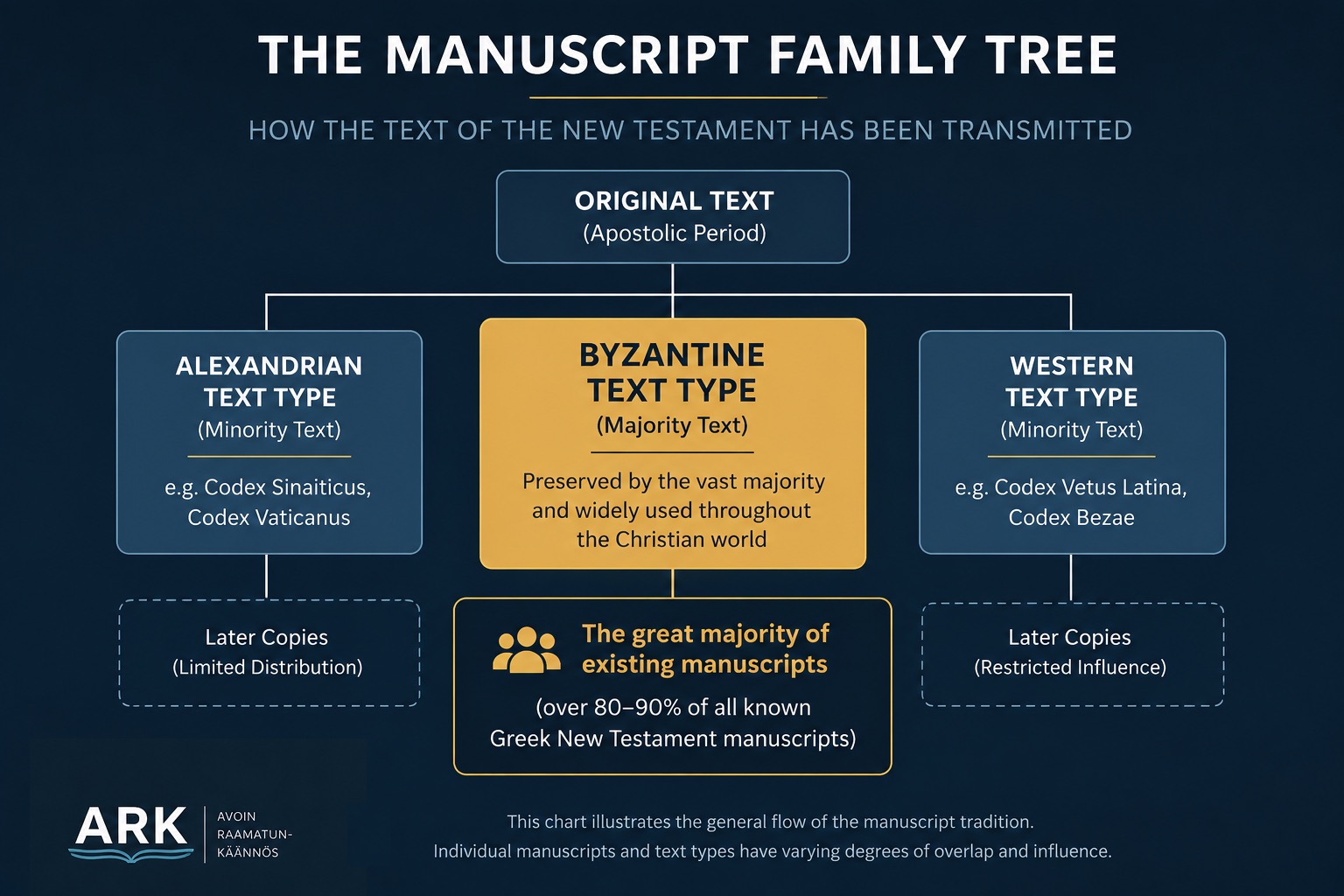
The surviving manuscripts of the New Testament can be thought of as witnesses. In a court of law, witnesses are heard and the truth is sought based on their testimony. For example, we may have seven witnesses whose testimony is highly consistent, and then two witnesses who each provide their own somewhat contradictory accounts. Naturally, the unified testimony of seven witnesses is more credible than the contradictory testimony of two. Of course, if someone is an eyewitness, their testimony may be given greater weight than that of others.
The original manuscripts have not survived because, due to the humid climate of the Mediterranean region and continuous use, these papyrus scrolls were eventually worn out from being read. They turned to dust. In addition, large numbers of these writings were burned during the persecutions of Christians. Nevertheless, thousands of copies have survived. The New Testament itself is the testimony of eyewitnesses concerning Jesus and the events of that time, but none of the surviving manuscripts can be regarded as an eyewitness among the manuscripts themselves that should be given greater weight than the others.
The Bible records where Christianity first spread and to which congregations Paul, for example, wrote his letters. The gospel spread from Jerusalem and quickly reached the regions surrounding the Mediterranean—particularly the areas of modern-day Turkey and Greece. Thousands of New Testament manuscripts have been discovered in these regions, and they were copied with the intention of faithfully reproducing the original manuscripts or their copies. Although these writings have been found across a wide geographical area, they are remarkably consistent. This family of texts is known as the Byzantine Text or the Majority Text.
We also possess a smaller group of manuscripts that differ more frequently from the Majority Text and exhibit greater variation among themselves. These manuscripts are generally considered to originate from Egypt, particularly within the sphere of influence of Alexandria. The critical text most commonly used today relies to a greater extent on this Alexandrian text type. The use of these manuscripts is often justified on the grounds that they are assumed to be the oldest surviving New Testament manuscripts and therefore potentially closest to the original form of the text. These manuscripts are often given considerable weight based on their presumed age, even though they too are merely copies of the original texts.
Alexandrian manuscripts are often regarded as the most reliable, yet anyone can examine, for example, the online version of Codex Sinaiticus and observe its numerous corrections and later layers of revision.
The discovery of Codex Sinaiticus was a turning point in the history of New Testament textual criticism. Previously, Codex Vaticanus stood largely alone as a representative of the Alexandrian text type, but the discovery of Sinaiticus provided it with a significant supporting witness. As a result, the focus of textual criticism increasingly shifted away from the Majority Text and toward the Alexandrian textual tradition.
However, the discovery of Codex Sinaiticus is also associated with some controversial details. Constantin von Tischendorf found these parchment leaves at St. Catherine's Monastery in 1844, reportedly among materials intended for use as kindling. This raises questions about the accuracy of Tischendorf's account: Why would the monks burn valuable parchment manuscripts in their ovens?
Another questionable detail concerns the appearance of Codex Sinaiticus. The pages of the first portion, which Tischendorf took with him from the monastery, are light in color with dark text, whereas the remaining portions are yellowish with faded writing. This has led some people to wonder whether the manuscript's appearance may have been affected by later handling or storage conditions.
On the other hand, Constantin Simonides claimed that Codex Sinaiticus had been commissioned by his elderly uncle, a monk on Mount Athos, and that he himself had completed it in great haste around 1839 while still a young man. In his own words, it was the "poor work of my youth." A debate followed in the English press, and the outcome was that Simonides came to be regarded as a fraud and forger, while Tischendorf became a celebrated hero. Although Simonides' claims are generally considered unreliable, the episode remains part of the discussion surrounding Codex Sinaiticus.
Even if Codex Sinaiticus is genuine and truly the oldest surviving manuscript of the New Testament, it is still only one manuscript among many and cannot be regarded as an eyewitness that should be given greater weight than the others.
Together with Codex Vaticanus and other manuscripts belonging to the Alexandrian tradition, it clearly represents a minority witness when the number of manuscripts is considered. Furthermore, this minority witness is not as uniform, as significantly more variations exist among these manuscripts than among the manuscripts of the Majority Text tradition.
Today, most Bible translations are based on the Nestle–Aland text or the text of the United Bible Societies. This critical text has been constructed through scholarly textual-critical methods by combining readings from various manuscripts.
Although this method is intended to help recover the most original form of the text possible, the result is nevertheless a text that is not found in any surviving manuscript. No church or congregation in history has ever used this text. If the critical text is substantially closer to the original wording than the Majority Text, it follows that God's people lacked the most original form of the text for more than a thousand years.
God has preserved His Word. Although the original manuscripts have apparently not survived, multiple highly consistent copies have been preserved and discovered across a wide geographical area. These texts were used by the congregations mentioned in the Bible, and despite persecutions and book burnings, they still constitute a clear majority of all discovered manuscripts. Although there are some variations within these Byzantine texts as well, the original reading can most often be determined by following the reading supported by the majority.
For this reason, the Finnish "Avoin Raamatunkäännös" (Open Bible Translation) is based on the Robinson–Pierpont Text, which represents the Byzantine Majority Text tradition.
Sami Kosonen
Project Director
18.6.2026
Please read also the article written by Dr. Maurice Robinson: The Case for Byzantine Priority (PDF)